Sharing Books, Sharing Bonds: Two Book-Sharing Projects Worth Knowing
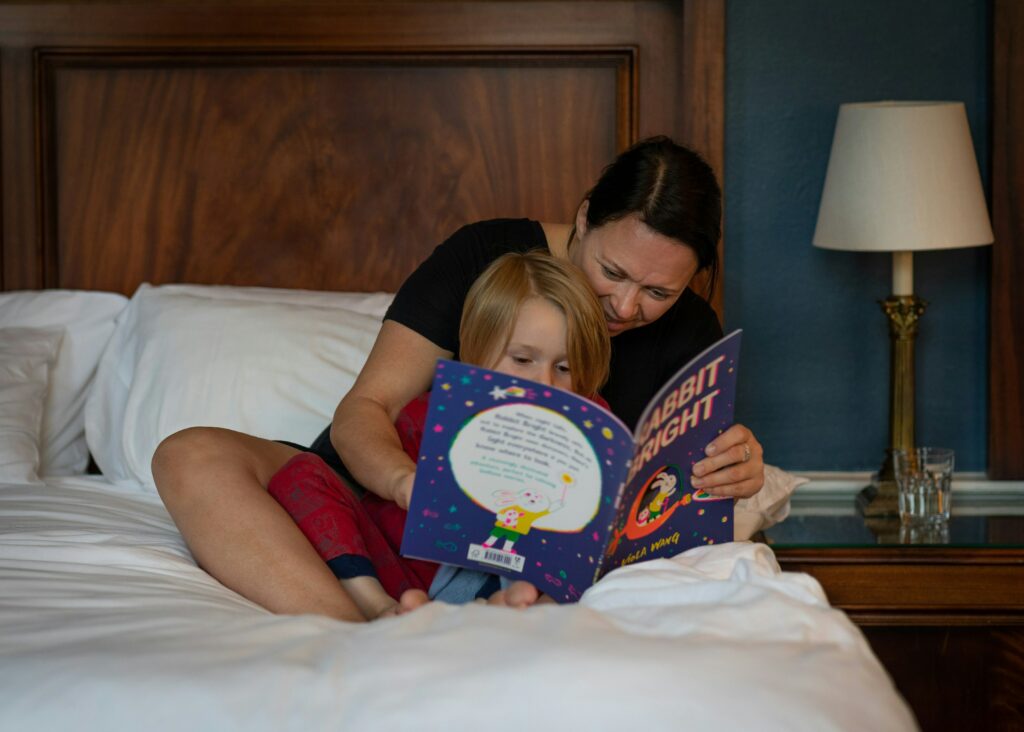
Book sharing is one of those parent-child moments. In this article, we’ll share two extraordinary projects that build on this. The first is Dolly Parton’s Imagination Library, a worldwide initiative that gifts books to children aged 0–5 to inspire them to love reading. The second is The Storybook Dads, which aims to sustain the bond between parent and child when circumstances separate them.
Book sharing and the benefits it brings
The time when you and your child explore a book together is called book sharing. This might include reading a book, looking at the images, discussing them, and talking about all the non-book-related stuff. But this can also be discovering the book as an object – touching it, turning the pages, recognising shapes, letters and so on. These very private moments you spend together over a book during the day or just before bedtime were an object of study for many scientists. They were curious about what mutual benefits it brings to parents and children, and what motivates them to spend time together over a book. Some of the results below are intuitive, but others might surprise you.
For children, the benefits from book sharing are wide-ranging. Researchers link regular book-sharing to vocabulary growth, richer language acquisition, greater knowledge of story structure, and stronger later reading achievement, partly because books tend to use more complex and varied vocabulary than everyday speech or television.
Parents, too, gain from the experience – studies show increased confidence, a stronger sense of connection with their child, and even gentler, less harsh parenting over time, though the exact direction of these effects isn’t always clear.
But what also matters in book sharing is the quality of parent-child interaction. Securely attached parent-child pairs tend to read in a relaxed, child-led way, following the child’s interests rather than rigidly sticking to the text. This results in more engaged, positive experiences for both. By contrast, researchers associate overly rigid or purely functional reading styles with frustration or disengagement in children. This relational quality distinguishes book-sharing from formal reading instruction. Over time, positive early experiences of book-sharing can shape a child’s attitude toward reading, nurturing not just literacy skills but a genuine enjoyment of books. The latter, as some scientists state, matters even more for educational outcomes than family socioeconomic background.
Dolly Parton’s Imagination Library
‘Inspiring kids to love to read became my mission. In the beginning, my hope was simply to inspire the children in my home county, but here we are today with a worldwide program that gives a book a month to well over 3 million children’[1] – explains Dolly Parton, world-famous singer, her motivation for launching book gifting programme. The idea is very simple: each child engaged in the programme receives one book a month for free until the age of 5. Over 30 years of activity, the Dollywood Foundation has given 304,539,509 books to children worldwide by the end of 2025[2]. First, the Imagination Library was present in the USA, then spread to Canada (since 2006), the United Kingdom (since 2007), Australia (since 2013) and the Republic of Ireland (since 2019).
In each country, a local partner organisation recruits children to the programme, selects books, covers wholesale book costs, and mails them to children in its coverage area. The Dollywood Foundation handles the overhead costs and negotiates book prices. Families are not burdened with any costs. The program is open to evolve – each organisation can become a local partner.
In each participating country, a committee is responsible for book selection. The committee includes teachers, librarians, educators, and other specialists in the field. They choose an age-appropriate list of publications selected for the current year. You’ll find them among the classics of children’s literature, as well as new titles[3]. The books in the US include bilingual and Braille ones.
Dolly Parton’s initiative and its impact on Imagination Library participants have been the subject of at least two scientific studies: one in the UK and one international. The UK research is a PhD thesis by Caroline Zwierzchowska-Dod[4]. Her findings show that families in the Imagination Library programme read to their kids more often, and children who received the books for a year or more outperformed their peers on key reading and development measures by age five. What is more, parents said the programme filled their homes with more books and introduced them to new authors and stories, no matter their income or how many books they already owned. Most parents felt it brought them closer to their children, helped them understand their child’s likes and dislikes, and made reading together a genuinely relaxing, joyful part of the day.
The other study was an international study led by Dr Claire Melanie Anita Galea, an Australian researcher. She surveyed over 86,000 caregivers across the US, Canada, UK, Australia, and Ireland. After just 10 books, children enrolled in the Imagination Library programme were four times more likely to show stronger early literacy skills, such as vocabulary and phonological awareness. They were also nine times more likely to be read to regularly, nine times more likely to show real interest in books, and fifteen times more likely to actively join in during story time. Caregivers changed too, becoming far more likely to describe pictures, count images, and let their child hold the book.
The results of both studies clearly show that Dolly Parton’s Imagination Library is an impactful initiative shaping children’s literacy skills from the very early years. But, as we already showed at the beginning of the text, book sharing also builds family bonds. And what happens when the bond is threatened because one parent suddenly becomes absent at home, because they… go to prison.
The Storybook Dads (and Mums)
Picture this: a father in prison, sitting with a children’s book and a microphone, reading their child a bedtime story. Maybe it’s the first time they do so, because earlier, in freedom, there was somehow no occasion for book sharing. That’s where the Storybook Dads begins. It all began in 2002, when prison officer Sharon Berry worked with the Writer in Residence at HMP Channings Wood in Devon to develop the idea. When Sharon moved to HMP Dartmoor, she brought the scheme with her, and it wasn’t long before other prisons heard about it and wanted to join. A year later, in 2003, Storybook Dads had become a registered charity, and a dedicated editing centre was set up at HMP Dartmoor, staffed by prisoners trained in audio and video production.
In each participating prison, usually through the library or family services team, a father records himself reading a storybook aloud. He doesn’t need to be a confident reader or a tech expert: staff and trained peer-editors are on hand to help, and even non-readers can take part, since the recording is refined afterwards. Once the recording is made, it’s sent to the production centre, where a small team cleans it up, adds sound effects and music, and turns it into a polished audio or video story. The finished recording is then posted home, so the child can press play and hear their dad’s voice whenever they need it: at bedtime, during the day or simply whenever they miss him.
Today, Storybook Dads supports around 100 prisons across the UK, including women’s prisons (as Storybook Mums), and a few young offender institutions along with secure hospitals. The charity has also trained the Army, Navy and Air Force to run their own version for deployed personnel, so children of service members can stay connected too. The project’s model has been recognised internationally, advising organisations in Australia, Denmark, Poland, Hungary, Hong Kong, Portugal and Japan on setting up similar schemes.
The Storybook Dads has become a very powerful initiative on many levels for both parents and children. For children, it offers the chance to hear a familiar voice, a story, and a sense that they haven’t been forgotten. For parents, it restores a role that prison so easily strips away – that of the reader, the comforter, the one who tucks you in. As one father put it: ‘My biggest fear was that when I got out, my children wouldn’t know me. Storybook Dads changed that – it meant I could read them a story and in a small way could still be there at bedtime’[5].
The two projects we presented in this article focus on different aspects of book-sharing. Dolly Parton’s Imagination Library aims to spark children’s love for books and develop their early language literacy skills. Story Book Dads (and Mums) pay special attention to sustaining parent-child bonds when separated by circumstances. But as evidence from both of them clearly shows, book sharing is also beneficial for parents.
Resources:
[1] Dolly Parton’s Imagination Library, “A Letter from Dolly,” Imagination Library, accessed 19 August 2026, https://imaginationlibrary.com/letter-from-dolly/.
[2] Dolly Parton’s Imagination Library, “Year in Review,” Imagination Library, accessed 19 August 2026, https://imaginationlibrary.com/news-resources/year-in-review/.
[3] Exemplary book list for the USA in 2026: Dolly Parton’s Imagination Library, “USA Book List,” Imagination Library, accessed 19 August 2026, https://imaginationlibrary.com/usa/book-list.
[4] Caroline Zwierzchowska-Dod, “Books, Babies and Bonding: The Impact of Dolly Parton’s Imagination Library on Parental Engagement in Book-Sharing and on Child Development from 0–5 Years Old” (PhD thesis, Swansea University, 2022), https://cronfa.swan.ac.uk/Record/cronfa60121.
[5] Storybook Dads, “For Funders,” Storybook Dads, accessed 19 August 2026, https://www.storybookdads.org.uk/Pages/Category/for-funders.