Sound of Stories 2.0: sounds like fun learning!
Speaking your native language seems so easy and natural – everybody around us does it! But in reality, learning to speak and acquiring new words is quite an effort.
While we often associate literacy with the ability to read and write, its true foundation lies in speech. For a child, the jump from communicating through simple gestures to mastering complex speech is a steep climb. It is a sophisticated process that requires the brain to decode sounds, attach meanings, and replicate them. This journey can be made even more difficult by factors such as developmental delays, limited exposure to diverse vocabulary, or Specific Learning Disorders (SLDs), which can create early barriers to communication (Catts, 2021; Kennedy et al., 2012).
The Vision: Listening as a Superpower
We address our project to young children, with a primary focus on developing their vocabulary. A study led by Oxford University Press (2018) shows that nearly 49% of young learners (5/7-year-olds) across Europe face vocabulary gaps that can hinder their long-term academic success.
To bridge this gap, The Sound of Stories 2.0 emerges as an ambitious international initiative.
Building on the massive success of the first edition, this project focuses on introducing sound-based learning for students aged 3 to 8.
Why sound-based learning?
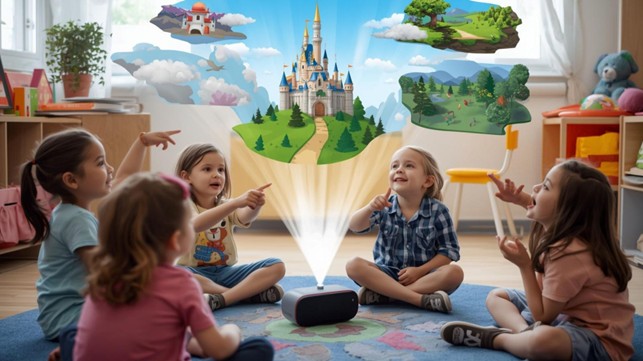
Do you remember that moment from your childhood when you heard a new, intriguing sound? That “itchy” need to share your impressions and emotions immediately? We transform this natural urgency into a storytelling opportunity. By engaging a child’s sense of hearing through audio stories and soundscapes, we unlock their imagination. When a student hears the crunch of snow or the distant hum of a market, they aren’t just listening; they feel compelled to describe it and express the emotions it evokes. And that’s how a storytelling situation creates itself from a simple sound.
What’s New in 2.0?
While students are at the heart of the project, we recognise that teachers lead the way. Many educators today feel a “digital gap” and lack the self-confidence to implement innovative pedagogy. Overwhelmed by professional responsibilities and the struggle to balance work and private life, they often lack the mental space for self-development.
To support them, Sound of Stories 2.0 is creating a comprehensive digital ecosystem. We are providing them with tools that teachers can integrate seamlessly into their daily routines:
- A 5-Module Online Course: Training educators in sound-based learning and digital sound editing that teachers and educators can take at their own pace
- Teacher Workshop Plans: Hands-on, ready-to-use lesson plans
- A database of sounds and soundscapes: a collection of various sounds for classroom use.
- Recording standards guidelines: A “how-to” for anyone wanting to create high-quality educational audio.
- Activity sheets: Ready-to-use materials that make “sound lessons” easy to implement.
To ensure these tools are practical, over 80 teachers and 100 students will test them to confirm they meet the real-world needs of the classroom.
The path forward
At the end of this journey, we expect to see more than just “better grades”. We are fostering a transformation in which students gain the confidence to tell their own stories, and teachers feel tech-savvy and empowered. Most importantly, we are creating an inclusive environment where children with diverse needs can thrive through auditory engagement.
Literacy is the key to the world, but sound might just be the quickest way to turn the lock.
A Global Collaboration for Local Needs
Innovation thrives on diversity, and this project, led by Vesthimmerlands Museum (Denmark) is powered by a specialised partnership including ELAN (European Literacy for All Network, Belgium), Haubro Friskole og Børnehus (Denmark), Arsakeio Kindergarten of Patras (Greece), Gradinita Step By Step Cu Program Prelungit Si Program Normal Licurici (Romania), and the International Primary School of Innovative Education in Łódź (Poland).
By blending the expertise of museums, schools, and non-formal education centres, we ensure that our tools fit different learning contexts and traditions. Working together from the very beginning allows us to weave different pedagogical heritages into a single, powerful method that respects local needs while aiming for European-wide impact.
References
Catts, H.W. (2021), Commentary: The critical role of oral language deficits in reading disorders: reflections on Snowling and Hulme (2021). J. Child Psychol. Psychiatr., 62: 654-656. https://doi.org/10.1111/jcpp.13389
Cole, A., Brown, A., Clark, C., & Picton, I. (2022). Children and young people’s reading engagement in 2022: Continuing insight into the impact of the Covid-19 pandemic on reading. National Literacy Trust. https://literacytrust.org.uk/research-services/research-reports/children-and-young-peoples-reading-engagement-in-2022/
Kennedy, E., Dunphy, E., Dwyer, B., Hayes, G., McPhillips, T., Marsh, J., O’Connor, M., & Shiel, G. (2012). Literacy in Early Childhood and Primary Education (3-8 years) (Research Report No. 15). National Council for Curriculum and Assessment.